
Immersive spaces to evoke memories
Centuries of history in virtual reality
To recall
In 2012, a devastating earthquake struck the Bassa Modenese region, causing the collapse of the Church of San Francesco. The historic building, which had stood for nearly eight centuries through wars, sieges, and shifting dynasties, crumbled before the eyes of the citizens of Mirandola.
The right aisle collapsed along with its renowned stained-glass windows, the bell tower fell to the ground, and the pillars of the central nave gave way under the weight of the collapsing roof.
From a historical, artistic, and community perspective, the loss was irreparable. The church dates back to at least 1287 and is closely tied to the arrival of the Franciscan friars in the city.
In 2012, a devastating earthquake struck the Bassa Modenese region, causing the collapse of the Church of San Francesco. The historic building, which had stood for nearly eight centuries through wars, sieges, and shifting dynasties, crumbled before the eyes of the citizens of Mirandola.
The right aisle collapsed along with its renowned stained-glass windows, the bell tower fell to the ground, and the pillars of the central nave gave way under the weight of the collapsing roof.
From a historical, artistic, and community perspective, the loss was irreparable. The church dates back to at least 1287 and is closely tied to the arrival of the Franciscan friars in the city.
Over the centuries, it became an exceptional historical landmark, as the Pico family, nobles of Mirandola, chose it as their personal pantheon. Ninety-two prominent citizens of Mirandola were buried within its walls, along with those who contributed to the city’s legacy. The tombs of Prendiparte and Spinetta Pico stand out for their magnificence.
It was the nobles, together with the friars, who enriched the church over time with altars and important works of art, including the painting Saint Francis Receiving the Stigmata by Sante Peranda. They also commissioned the construction of the remarkable Chapel of the Blessed Virgin of Reggio, which during the twentieth century became an important place of civic memory, as it bears the names of those who died in the First and Second World Wars.
Thanks to VR technology applied to digital heritage, it is possible to reconstruct environments that have been lost over time or are temporarily inaccessible, allowing people to move freely within the space and interact with it. The goal is to enable the community to reconnect with historical and artistic heritage, transforming it into a personal experience.
Acquiring knowledge and expanding awareness should become an engaging and exciting experience, one that also includes the pleasure of discovery.
Over the centuries, it became an exceptional historical landmark, as the Pico family, nobles of Mirandola, chose it as their personal pantheon. Ninety-two prominent citizens of Mirandola were buried within its walls, along with those who contributed to the city’s legacy. The tombs of Prendiparte and Spinetta Pico stand out for their magnificence.
It was the nobles, together with the friars, who enriched the church over time with altars and important works of art, including the painting Saint Francis Receiving the Stigmata by Sante Peranda. They also commissioned the construction of the remarkable Chapel of the Blessed Virgin of Reggio, which during the twentieth century became an important place of civic memory, as it bears the names of those who died in the First and Second World Wars.
Thanks to VR technology applied to digital heritage, it is possible to reconstruct environments that have been lost over time or are temporarily inaccessible, allowing people to move freely within the space and interact with it. The goal is to enable the community to reconnect with historical and artistic heritage, transforming it into a personal experience.
Acquiring knowledge and expanding awareness should become an engaging and exciting experience, one that also includes the pleasure of discovery.
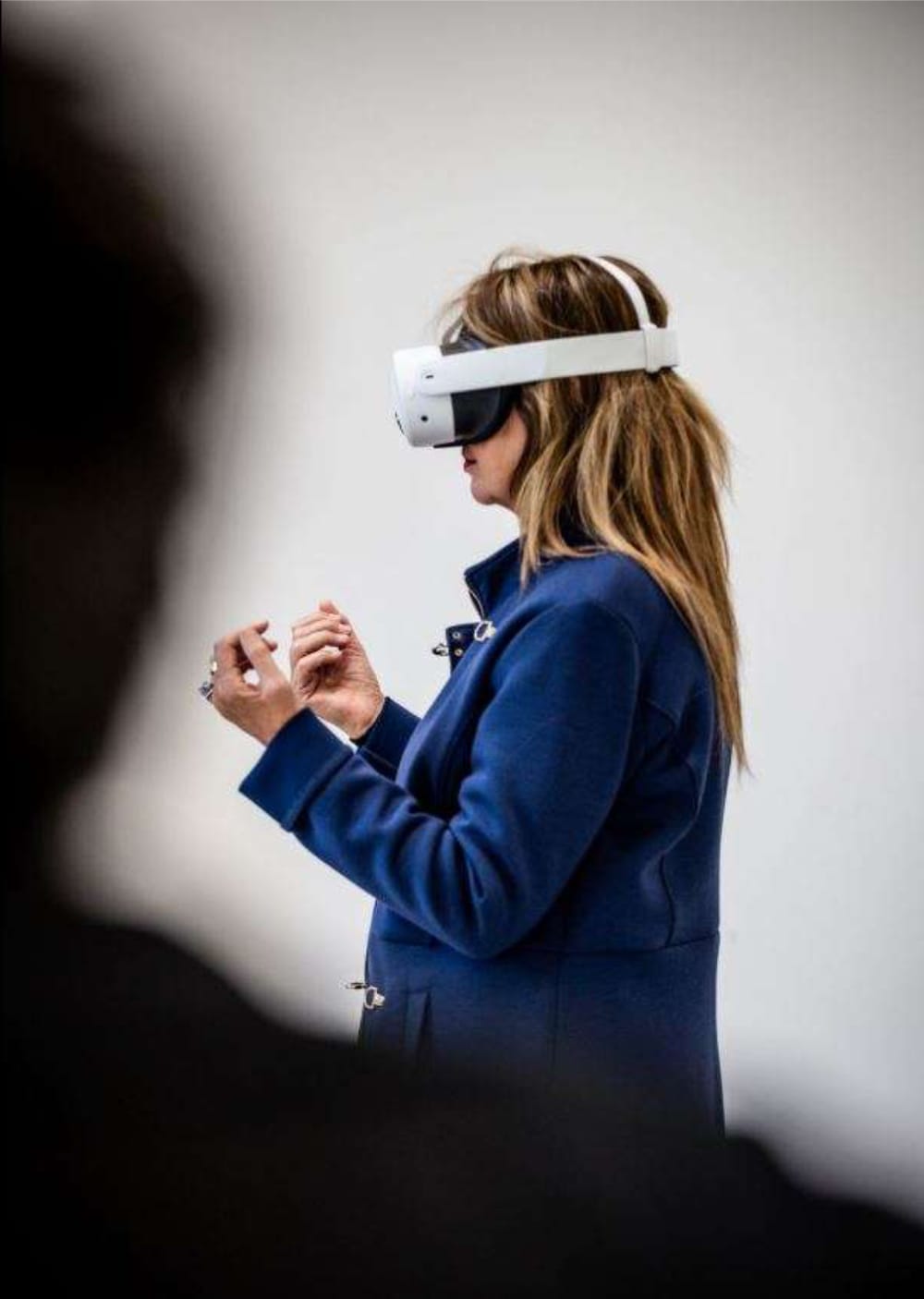
Public event for the “Quasi 8 Secoli” experience at the Cultural Center “Il Pico”, E. Garin Library. Archival photo, property of the Municipality of Mirandola.

Approach
In recent years, immersive technologies in the cultural sector in Italy have largely followed a single model: the generalist model, commonly seen in large-scale immersive exhibitions.
In this model, the goal is to create a cultural spectacle accessible to a broad audience. These are typically temporary installations with strong visual impact, designed for easy consumption and often tied to cultural tourism. Visitors are surrounded by images and visual flows; the experience is primarily spectacular, but largely passive.
Metrohive has developed its own approach: the Uncharted model.
In this framework, immersive technology is not only used to create a spectacle, but to rebuild the relationship between a community and its historical heritage. The audience is not generic but local, the experience is not temporary but civic, and the goal is not artistic reinterpretation, but the restitution of a place and its stories.
In recent years, immersive technologies in the cultural sector in Italy have largely followed a single model: the generalist model, commonly seen in large-scale immersive exhibitions.
In this model, the goal is to create a cultural spectacle accessible to a broad audience. These are typically temporary installations with strong visual impact, designed for easy consumption and often tied to cultural tourism. Visitors are surrounded by images and visual flows; the experience is primarily spectacular, but largely passive.
Metrohive has developed its own approach: the Uncharted model.
In this framework, immersive technology is not only used to create a spectacle, but to rebuild the relationship between a community and its historical heritage. The audience is not generic but local, the experience is not temporary but civic, and the goal is not artistic reinterpretation, but the restitution of a place and its stories.
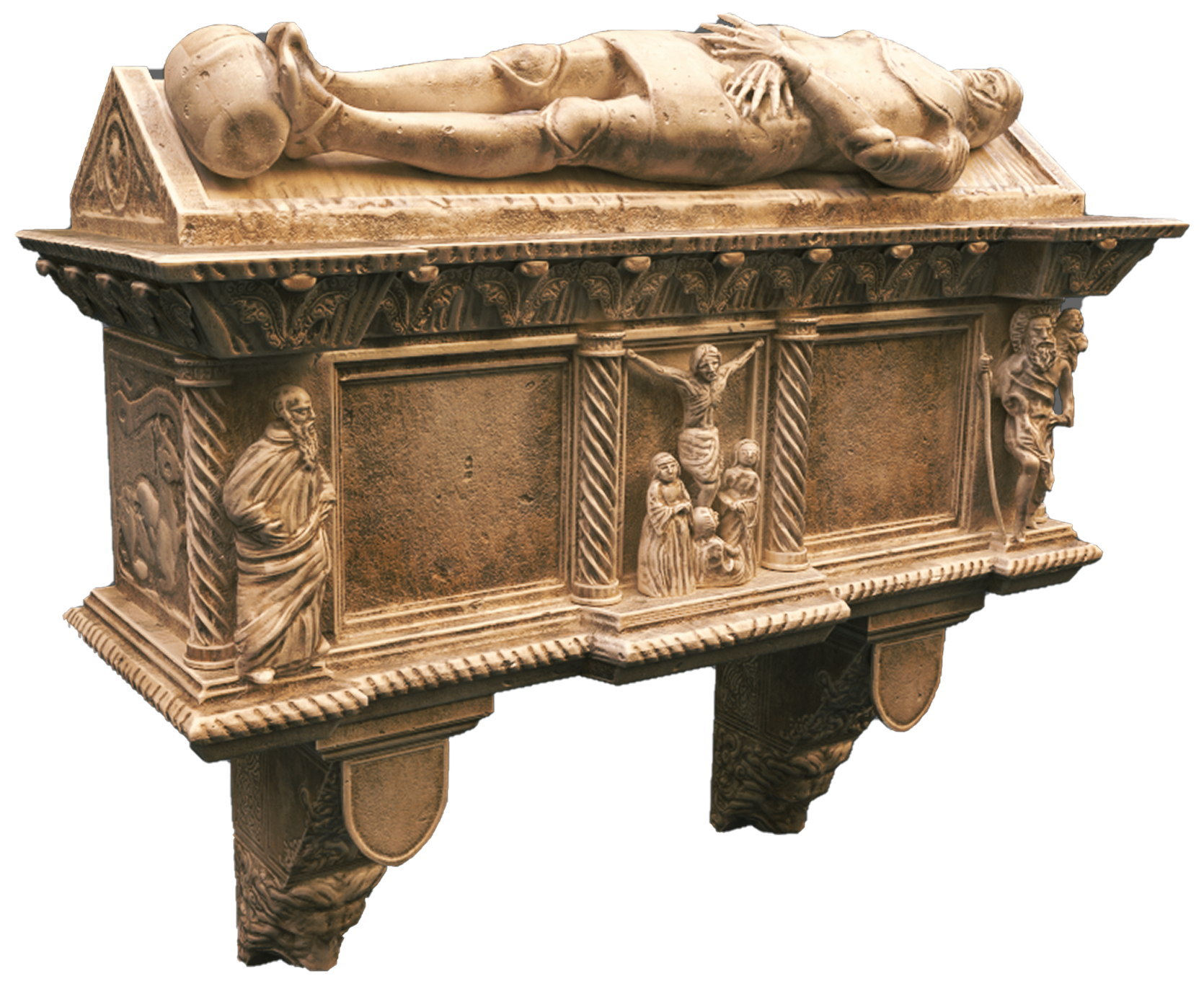
Arca di Prendiparte
Designed and modeled based on historical sources
Spectacle vs Participation
In the generalist model, immersion is often built through projections and audiovisual environments. The visitor is surrounded by images but remains an observer.
In the heritage model adopted in “Quasi 8 Secoli”, immersion instead takes place within a reconstructed three-dimensional space that the visitor can physically explore.
But the defining element is narrative.
The experience is not just an environment to visit; it is a story shaped by a precise direction, alternating lyrical, historical, and interactive moments. Characters, events, and situations emerge within the space as the visitor moves, turning exploration into a narrative journey through the memory of the place.
In this way, the user does not simply observe the church; they move through its history.
In the generalist model, immersion is often built through projections and audiovisual environments. The visitor is surrounded by images but remains an observer.
In the heritage model adopted in “Quasi 8 Secoli”, immersion instead takes place within a reconstructed three-dimensional space that the visitor can physically explore.
But the defining element is narrative.
The experience is not just an environment to visit; it is a story shaped by a precise direction, alternating lyrical, historical, and interactive moments. Characters, events, and situations emerge within the space as the visitor moves, turning exploration into a narrative journey through the memory of the place.
In this way, the user does not simply observe the church; they move through its history.
The Uncharted Model
The process begins with a research phase. Site visits are carried out, and testimonies and interviews are collected to understand which stories are most relevant to the place. These stories become the narrative core on which the experience is built.
At the same time, a process of source consultation is conducted: historical archives, documents, iconography, and testimonies are compared to reconstruct the context as accurately as possible. This research is carried out by professionals and forms the basis of the entire project.
The process begins with a research phase. Site visits are carried out, and testimonies and interviews are collected to understand which stories are most relevant to the place. These stories become the narrative core on which the experience is built.
At the same time, a process of source consultation is conducted: historical archives, documents, iconography, and testimonies are compared to reconstruct the context as accurately as possible. This research is carried out by professionals and forms the basis of the entire project.
Everything around you is dynamic. Light and shadow interact with the architectural reconstructions, carefully crafted through hundreds of hours of research rather than cold scans.
The digital heritage model developed by Metrohive does not focus only on the technical reconstruction of a space, but also explores what can be defined as the architecture of the invisible: the emotional relationship between a community and a lost place.
For this reason, the method draws more from fine arts and narrative than from pure technology. The design of the experience considers spatial construction, narrative direction, and the emotional perception of the visitor with equal importance.
Each experience becomes a journey built around the memory of a place.
No didactic storytelling, third-party assets, or simplified environments are used. The goal is not to create a spectacular representation, but to restore a credible presence of the space.
The heritage model is based on three fundamental conditions that make the experience possible:
- The user enters a place they once knew.
- That place is no longer accessible.
- That place is part of their personal or collective identity.
When these three conditions are met, virtual reality can generate strong emotional engagement.
The digital heritage model developed by Metrohive does not focus only on the technical reconstruction of a space, but also explores what can be defined as the architecture of the invisible: the emotional relationship between a community and a lost place.
For this reason, the method draws more from fine arts and narrative than from pure technology. The design of the experience considers spatial construction, narrative direction, and the emotional perception of the visitor with equal importance.
Each experience becomes a journey built around the memory of a place.
No didactic storytelling, third-party assets, or simplified environments are used. The goal is not to create a spectacular representation, but to restore a credible presence of the space.
The heritage model is based on three fundamental conditions that make the experience possible:
- The user enters a place they once knew.
- That place is no longer accessible.
- That place is part of their personal or collective identity.
When these three conditions are met, virtual reality can generate strong emotional engagement.
Interactive narrative
The Uncharted Model uses a clear narrative structure to guide the visitor through the space.
The experience follows a progressive sequence:
space → discovery → activation → event
The visitor enters the environment, begins to orient themselves, gradually discovers elements of the space and, through interaction, activates narrative events that reveal the story of the place.
The journey follows a natural progression:
enter → orient → discover → the story emerges
The narrative is not imposed from the outside, but emerges from the space itself, turning exploration into a process of discovery.
In this way, each visit becomes a personal experience, capable of reactivating the relationship between the visitor and a place they remember.
The project “Quasi 8 Secoli” shows that immersive experiences can go beyond visual spectacle.
Through spatial reconstruction, physical interaction, and a strong narrative direction, virtual reality becomes a tool capable of restoring a lost place and reactivating the collective memory of the community.
The Uncharted Model uses a clear narrative structure to guide the visitor through the space.
The experience follows a progressive sequence:
space → discovery → activation → event
The visitor enters the environment, begins to orient themselves, gradually discovers elements of the space and, through interaction, activates narrative events that reveal the story of the place.
The journey follows a natural progression:
enter → orient → discover → the story emerges
The narrative is not imposed from the outside, but emerges from the space itself, turning exploration into a process of discovery.
In this way, each visit becomes a personal experience, capable of reactivating the relationship between the visitor and a place they remember.
The project “Quasi 8 Secoli” shows that immersive experiences can go beyond visual spectacle.
Through spatial reconstruction, physical interaction, and a strong narrative direction, virtual reality becomes a tool capable of restoring a lost place and reactivating the collective memory of the community.
Design
Virtual reality is no longer confined to a simple technological gimmick, often associated with large immersive exhibitions that, while visually impressive, rarely leave a lasting historical or emotional impact on the visitor.
In this project, virtual reality is not used as a visual spectacle, but as an experiential space. The user experiences it standing and can move freely within a defined area: one step in the real world corresponds to one step inside the reconstructed church.
It is important to note that this is not a 360-degree video, often presented as virtual reality in many immersive installations. In this case, the environment is fully three-dimensional and interactive, allowing the visitor to explore the space and interact with its elements.
For those who experienced, loved, and ultimately lost that place, this mechanism can trigger a form of spatial memory, reactivating personal memories connected to a space that no longer exists.
Virtual reality is no longer confined to a simple technological gimmick, often associated with large immersive exhibitions that, while visually impressive, rarely leave a lasting historical or emotional impact on the visitor.
In this project, virtual reality is not used as a visual spectacle, but as an experiential space. The user experiences it standing and can move freely within a defined area: one step in the real world corresponds to one step inside the reconstructed church.
It is important to note that this is not a 360-degree video, often presented as virtual reality in many immersive installations. In this case, the environment is fully three-dimensional and interactive, allowing the visitor to explore the space and interact with its elements.
For those who experienced, loved, and ultimately lost that place, this mechanism can trigger a form of spatial memory, reactivating personal memories connected to a space that no longer exists.
In addition to acting as an assistant, the sphere can be picked up and used as a lantern, helping the user illuminate the artifacts within the church.
Beyond digitization
The philological reconstruction of the building is the result of hundreds of hours of research, drawing, and modeling. It is fundamentally different from simple scanning, which in this case would not be usable: it is an interpretative process aimed at restoring a perceptually credible architecture.
The spatial quality of a historical building is not only a matter of measurements or proportions. It carries an emotional and symbolic weight that Metrohive has chosen not to delegate to automated solutions.
Not only the architectural structure, but every element, from textures to liturgical details, has been designed to function within the immersive experience, avoiding shortcuts and simplified solutions.
The philological reconstruction of the building is the result of hundreds of hours of research, drawing, and modeling. It is fundamentally different from simple scanning, which in this case would not be usable: it is an interpretative process aimed at restoring a perceptually credible architecture.
The spatial quality of a historical building is not only a matter of measurements or proportions. It carries an emotional and symbolic weight that Metrohive has chosen not to delegate to automated solutions.
Not only the architectural structure, but every element, from textures to liturgical details, has been designed to function within the immersive experience, avoiding shortcuts and simplified solutions.
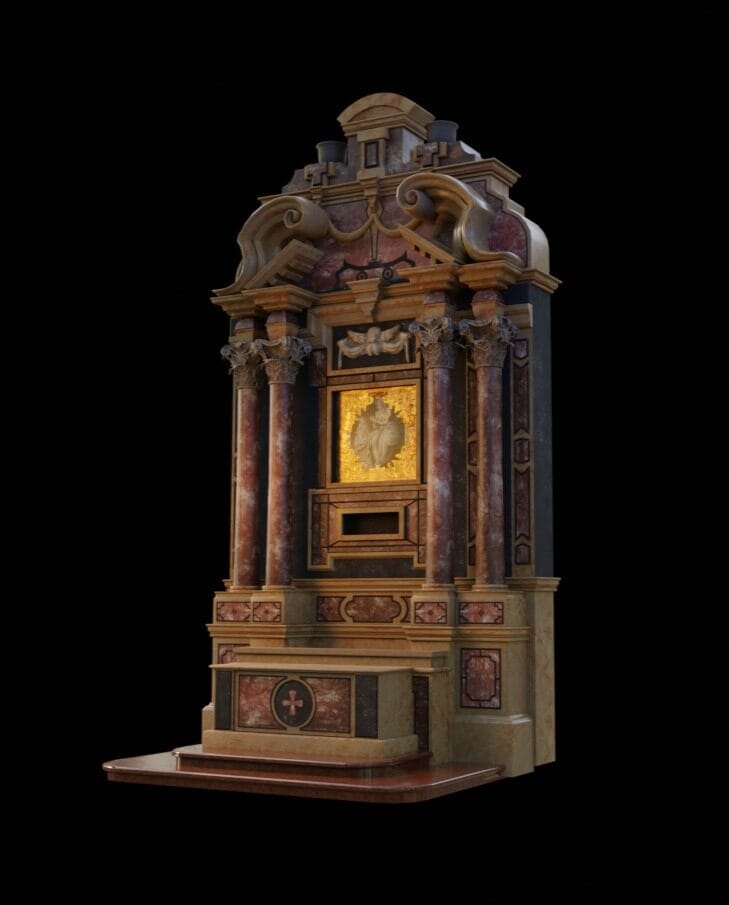
Altar of Beata Vergine di Reggio
Designed and modeled from historical sources
User centered
Quasi 8 Secoli opens a door. It shows that technological experimentation is worth the risk and that immersive technologies can be used to restore meaning to places and stories that belong to a community.
For years, many immersive experiences have favored spectacular and generalist models, designed for large audiences and driven by entertainment logic. While effective in creating striking visuals, these formats rarely place the visitor and their personal connection to the experience at the center.
In this project, the goal is different: to put the user at the center of the experience, allowing them to enter a space, explore it, and reconnect with a real place, its history, and the collective memory that runs through it.
Quasi 8 Secoli opens a door. It shows that technological experimentation is worth the risk and that immersive technologies can be used to restore meaning to places and stories that belong to a community.
For years, many immersive experiences have favored spectacular and generalist models, designed for large audiences and driven by entertainment logic. While effective in creating striking visuals, these formats rarely place the visitor and their personal connection to the experience at the center.
In this project, the goal is different: to put the user at the center of the experience, allowing them to enter a space, explore it, and reconnect with a real place, its history, and the collective memory that runs through it.
Welcome Phase
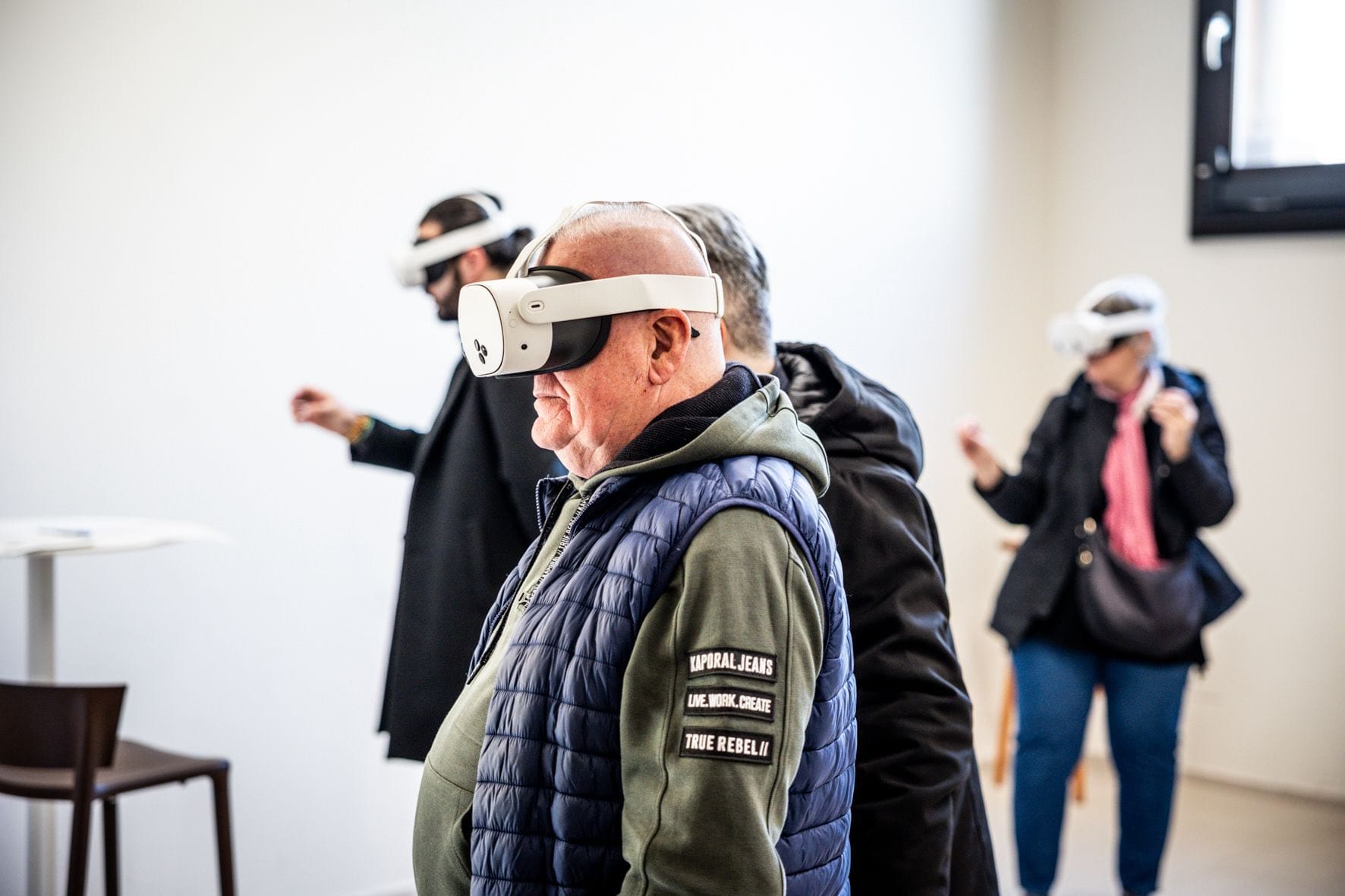
The queue included around 80 people, with an audience mainly composed of visitors between 50 and 70 years old. This was a target group that was initially curious but also skeptical toward the technology, and in most cases had never experienced virtual reality before.
This represented an important test, also because the experience requires active participation: users interact through hand tracking and move within the space using their bodies, not just head movement.
At the end of the experience, many visitors leave amazed and, in some cases, visibly moved. Many stop to share personal memories connected to the church, recounting episodes from their lives or adding details and insights about the history of the place. It is not uncommon for the experience to end with a spontaneous thank you, for having restored, even if only for a few minutes, the possibility of re-entering a space so meaningful to the city’s memory.
The queue included around 80 people, with an audience mainly composed of visitors between 50 and 70 years old. This was a target group that was initially curious but also skeptical toward the technology, and in most cases had never experienced virtual reality before.
This represented an important test, also because the experience requires active participation: users interact through hand tracking and move within the space using their bodies, not just head movement.
At the end of the experience, many visitors leave amazed and, in some cases, visibly moved. Many stop to share personal memories connected to the church, recounting episodes from their lives or adding details and insights about the history of the place. It is not uncommon for the experience to end with a spontaneous thank you, for having restored, even if only for a few minutes, the possibility of re-entering a space so meaningful to the city’s memory.
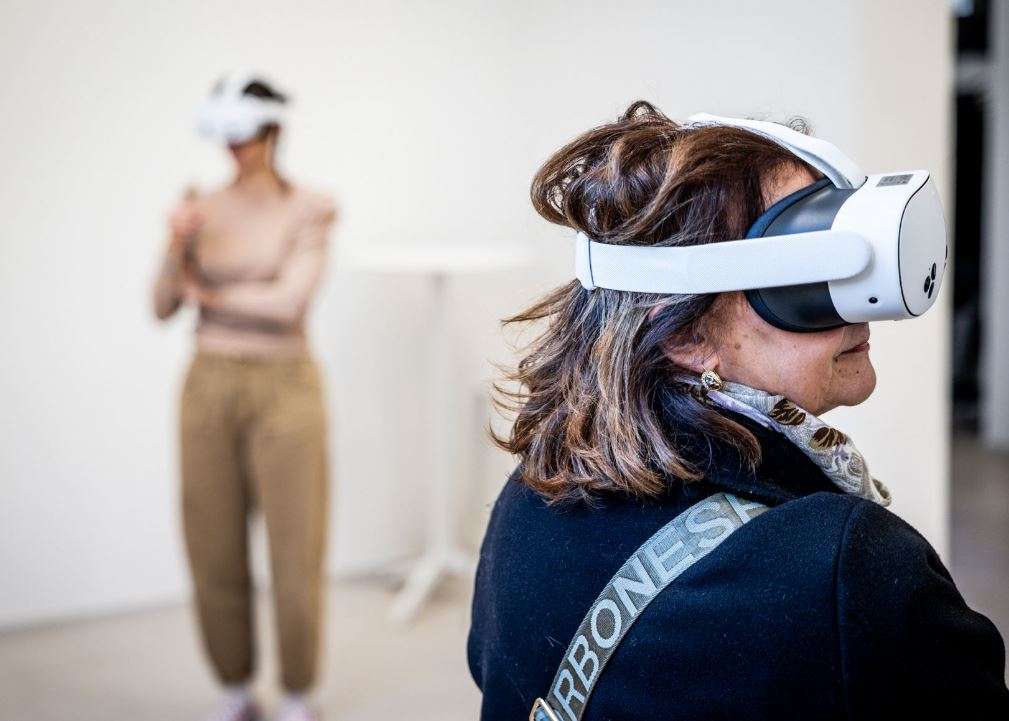
Onboarding and system check
One of the most critical aspects in developing an immersive experience for a general audience is the onboarding phase, the moment when the user enters the virtual environment for the first time and understands how to move and interact within the space.
In the case of “Quasi 8 Secoli”, this phase also represented an important operational test. During the public presentation, the experience was tested on an audience mainly composed of visitors between 50 and 70 years old, many of whom had never used a VR headset before.
Despite the complete lack of familiarity with the technology, the experience proved immediately understandable. The interaction system, based mainly on hand tracking and physical movement within the space, allowed even less experienced users to quickly orient themselves inside the virtual environment.
In the case of “Quasi 8 Secoli”, this phase also represented an important operational test. During the public presentation, the experience was tested on an audience mainly composed of visitors between 50 and 70 years old, many of whom had never used a VR headset before.
Despite the complete lack of familiarity with the technology, the experience proved immediately understandable. The interaction system, based mainly on hand tracking and physical movement within the space, allowed even less experienced users to quickly orient themselves inside the virtual environment.
This result is particularly significant considering that the experience lasts around 20 minutes and requires active participation. The user does not simply observe the environment, but interacts with objects and moves physically within the reconstructed church.
This result is particularly significant considering that the experience lasts around 20 minutes and requires active participation. The user does not simply observe the environment, but interacts with objects and moves physically within the reconstructed church.
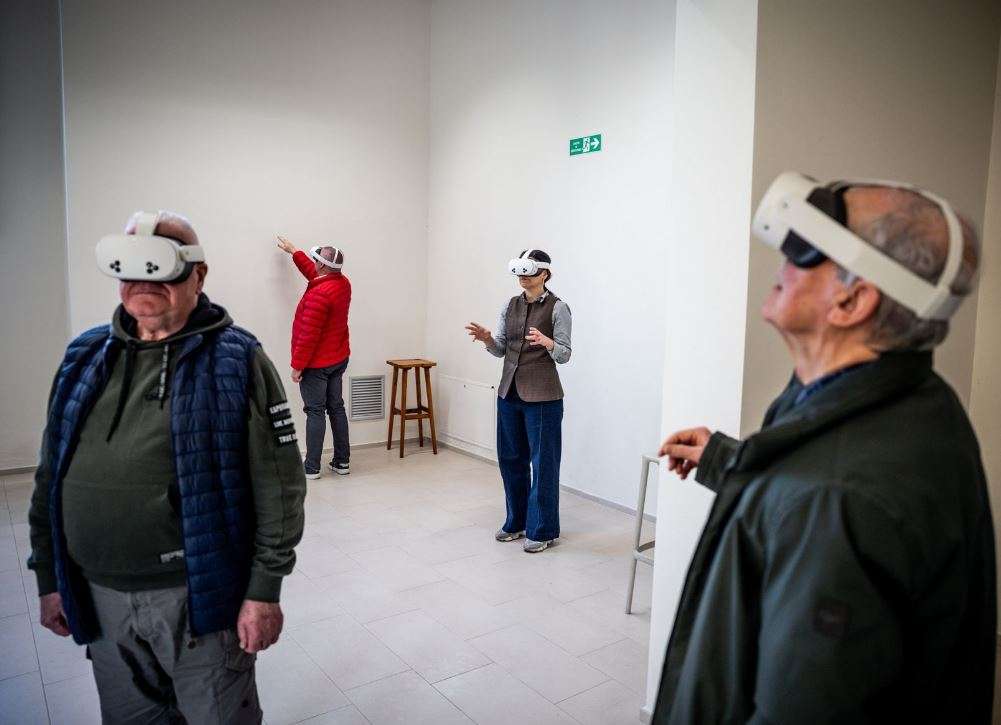
From an operational standpoint, the installation initially launched with 4 VR headsets and was later expanded to 8 simultaneous devices to handle the high number of visitors. The entire system ran without technical issues, despite the relatively limited space of the room where the experience took place.
The team remained on site throughout the event to assist visitors and directly observe user behavior. This live diagnostics phase made it possible to assess the effectiveness of the onboarding and the clarity of the interactions, showing that even users unfamiliar with the technology could quickly orient themselves within a complex immersive experience.
From an operational standpoint, the installation initially launched with 4 VR headsets and was later expanded to 8 simultaneous devices to handle the high number of visitors. The entire system ran without technical issues, despite the relatively limited space of the room where the experience took place.
The team remained on site throughout the event to assist visitors and directly observe user behavior. This live diagnostics phase made it possible to assess the effectiveness of the onboarding and the clarity of the interactions, showing that even users unfamiliar with the technology could quickly orient themselves within a complex immersive experience.
Setup
The “Quasi 8 Secoli” experience was designed not only as an immersive cultural project, but also as a permanent civic installation, accessible to the public at the Eugenio Garin Municipal Library in Mirandola.
The installation allows citizens and visitors to access the VR experience dedicated to the Church of San Francesco through a booking system managed via the official website of the Municipality of Mirandola, enabling an organized and continuous use over time.
To ensure full operability, Metrohive provided training for the staff responsible for managing the headsets, supplying the necessary instructions for startup, restart, and proper use of the installation.
The system was designed to be simple and autonomous in its daily operation. Thanks to the proprietary MetroKiosk solution, the experience can be restarted directly from the headset through a simple command sequence, allowing the system to be quickly reset between sessions.
If more advanced control is required, the installation can also be managed through a monitoring screen or tablet, enabling operators to check device status and facilitate session management.
In addition to local management, Metrohive provides remote support, allowing technical interventions and system checks without the need for on-site presence.
The entire system was tested during the public presentation phase under intensive and simultaneous use of multiple headsets, demonstrating operational stability and ease of management even with a large audience.
Metrohive also ensures compatibility and maintenance of the experience for the next three years, providing technical updates and support to keep the installation fully operational over time.
Through this installation, virtual reality becomes a stable tool for accessing the city’s cultural heritage, giving citizens the opportunity to re-enter a space that is no longer accessible today.
The “Quasi 8 Secoli” experience was designed not only as an immersive cultural project, but also as a permanent civic installation, accessible to the public at the Eugenio Garin Municipal Library in Mirandola.
The installation allows citizens and visitors to access the VR experience dedicated to the Church of San Francesco through a booking system managed via the official website of the Municipality of Mirandola, enabling an organized and continuous use over time.
To ensure full operability, Metrohive provided training for the staff responsible for managing the headsets, supplying the necessary instructions for startup, restart, and proper use of the installation.
The system was designed to be simple and autonomous in its daily operation. Thanks to the proprietary MetroKiosk solution, the experience can be restarted directly from the headset through a simple command sequence, allowing the system to be quickly reset between sessions.
If more advanced control is required, the installation can also be managed through a monitoring screen or tablet, enabling operators to check device status and facilitate session management.
In addition to local management, Metrohive provides remote support, allowing technical interventions and system checks without the need for on-site presence.
The entire system was tested during the public presentation phase under intensive and simultaneous use of multiple headsets, demonstrating operational stability and ease of management even with a large audience.
Metrohive also ensures compatibility and maintenance of the experience for the next three years, providing technical updates and support to keep the installation fully operational over time.
Through this installation, virtual reality becomes a stable tool for accessing the city’s cultural heritage, giving citizens the opportunity to re-enter a space that is no longer accessible today.
The sphere is an intelligent assistant that, in addition to acting as a narrator, provides the user with cues and suggestions on where to direct their attention.
Educational
In addition to its role as a permanent civic installation, “Quasi 8 Secoli” was also designed as an educational tool for local schools.
The headsets used for the experience will be employed in educational activities for students, allowing younger generations to discover a place many of them have never seen. The Church of San Francesco, in fact, collapsed in 2012, and for many young people in Mirandola it now exists only through stories and photographs.
Through the immersive experience, students can virtually enter the building and explore the stories, people, and events that shaped the life of the city over the centuries.
The project uses a language familiar to younger generations: interactive exploration and spatial storytelling, formats they recognize through their everyday experience with video games, cinema, and digital media.
In this sense, the VR experience becomes a bridge between generations.
On one side are older citizens, who experienced the church and retain a direct memory of it. On the other are younger generations who have never had the chance to know it. The immersive experience connects these two dimensions, turning cultural heritage into a story that is accessible even to those who have never seen it.
Virtual reality is therefore not the goal of the experience, but the medium through which stories, memories, and local identity are conveyed to younger generations, using tools and languages that belong to their world.
In this way, technology becomes a narrative vessel, capable of carrying the memory of a lost place into the present and making it alive again for those who will preserve it in the future.
In addition to its role as a permanent civic installation, “Quasi 8 Secoli” was also designed as an educational tool for local schools.
The headsets used for the experience will be employed in educational activities for students, allowing younger generations to discover a place many of them have never seen. The Church of San Francesco, in fact, collapsed in 2012, and for many young people in Mirandola it now exists only through stories and photographs.
Through the immersive experience, students can virtually enter the building and explore the stories, people, and events that shaped the life of the city over the centuries.
The project uses a language familiar to younger generations: interactive exploration and spatial storytelling, formats they recognize through their everyday experience with video games, cinema, and digital media.
In this sense, the VR experience becomes a bridge between generations.
On one side are older citizens, who experienced the church and retain a direct memory of it. On the other are younger generations who have never had the chance to know it. The immersive experience connects these two dimensions, turning cultural heritage into a story that is accessible even to those who have never seen it.
Virtual reality is therefore not the goal of the experience, but the medium through which stories, memories, and local identity are conveyed to younger generations, using tools and languages that belong to their world.
In this way, technology becomes a narrative vessel, capable of carrying the memory of a lost place into the present and making it alive again for those who will preserve it in the future.
Experience
After thirteen years during which the citizens of Mirandola walked past the ruins of the church, we restored the possibility to enter this building again through virtual reality, in partnership with the Municipality of Mirandola.
Through a meticulous digital heritage process, we recreated a faithful version of the church’s architectural structure, now accessible through Quest 3 headsets. But walking inside a building lost in time is not the only defining aspect of the experience: we designed a narrative with a clear direction, alternating melancholic and humorous moments, held together by a cohesive poetic tone.
The user is guided by an entity representing time, which gradually reconstructs the church and leads them through its spaces, revealing its stories and the people who once inhabited it.
Visitors can witness the disputes between the brothers Prendiparte and Spinetta Pico, as well as discover the devotion of the friars who, in the seventeenth century, attempted to keep the plague away from the town.
This is not a passive experience: the user is required to interact with the environment. The narration invites them to perform actions, from grabbing objects to ringing bells and blowing out candles.
This creates a varied form of interaction within the VR experience, where Quest 3 is used to track both body movements and voice input.
The experience extends beyond the interior of the church, including external spaces and different types of activities, such as flying over the convent and accessing the bell tower.
After thirteen years during which the citizens of Mirandola walked past the ruins of the church, we restored the possibility to enter this building again through virtual reality, in partnership with the Municipality of Mirandola.
Through a meticulous digital heritage process, we recreated a faithful version of the church’s architectural structure, now accessible through Quest 3 headsets. But walking inside a building lost in time is not the only defining aspect of the experience: we designed a narrative with a clear direction, alternating melancholic and humorous moments, held together by a cohesive poetic tone.
The user is guided by an entity representing time, which gradually reconstructs the church and leads them through its spaces, revealing its stories and the people who once inhabited it.
Visitors can witness the disputes between the brothers Prendiparte and Spinetta Pico, as well as discover the devotion of the friars who, in the seventeenth century, attempted to keep the plague away from the town.
This is not a passive experience: the user is required to interact with the environment. The narration invites them to perform actions, from grabbing objects to ringing bells and blowing out candles.
This creates a varied form of interaction within the VR experience, where Quest 3 is used to track both body movements and voice input.
The experience extends beyond the interior of the church, including external spaces and different types of activities, such as flying over the convent and accessing the bell tower.
By moving your tracked hands, you can fully interact with the world: extinguish candles, grab ropes, and ring bells.
Overview
Quasi 8 Secoli begins with an opening scene in which the user is invited to reassemble a small model of the church by repositioning the bell tower, which in reality was completely lost. This is a symbolic action that takes the user back in time, before the earthquake sequence, when the building was still intact.
Once the church has been reassembled, the experience officially begins. The user finds themselves in the streets of Mirandola, standing in front of the forecourt of San Francesco. Here they encounter the guiding entity of the experience: a sphere that changes color and invites the user to enter the church.
Throughout the experience, the sphere must be picked up multiple times to activate certain events.
After crossing the main door of San Francesco, the user is immediately struck by the accuracy of the architectural reconstruction and the liturgical furnishings, presented with a high level of detail for an experience developed on Quest 3.
By interacting with the sphere, the user is guided through some of the most significant elements of the church: the animated painting by Sante Peranda, the mosaic stained-glass windows, and the tombs of the Pico family.
Quasi 8 Secoli begins with an opening scene in which the user is invited to reassemble a small model of the church by repositioning the bell tower, which in reality was completely lost. This is a symbolic action that takes the user back in time, before the earthquake sequence, when the building was still intact.
Once the church has been reassembled, the experience officially begins. The user finds themselves in the streets of Mirandola, standing in front of the forecourt of San Francesco. Here they encounter the guiding entity of the experience: a sphere that changes color and invites the user to enter the church.
Throughout the experience, the sphere must be picked up multiple times to activate certain events.
After crossing the main door of San Francesco, the user is immediately struck by the accuracy of the architectural reconstruction and the liturgical furnishings, presented with a high level of detail for an experience developed on Quest 3.
By interacting with the sphere, the user is guided through some of the most significant elements of the church: the animated painting by Sante Peranda, the mosaic stained-glass windows, and the tombs of the Pico family.
Arca di Galeotto Pico
Designed and modeled from historical sources
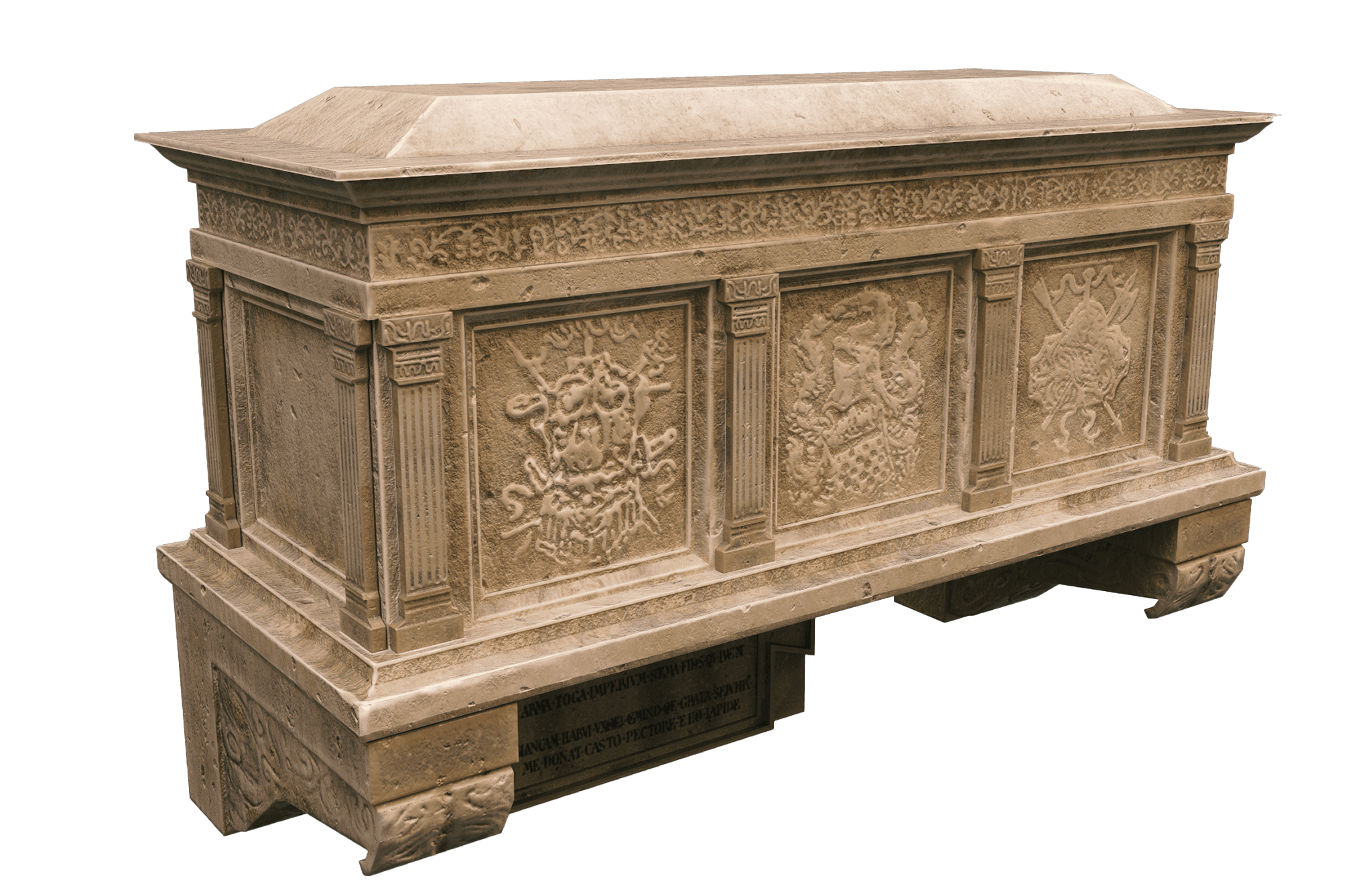
By climbing a staircase, the user can closely observe the tombs of Prendiparte and Spinetta Pico, historical figures who materialize in front of them and engage in a realistic and often lighthearted dialogue, capable of bringing a smile to the viewer.
This is followed by a contrasting scene in which Spinetta Pico appears alone, the last survivor, mourning his brother Prendiparte and recalling how meaningful it was to govern alongside him.
The user can then take a closer look at the funerary monument dedicated to the philosopher Giovanni Pico, whose actual tomb is located in Florence.
The sphere then guides the user to the chapel of the fallen and the Chapel of the Blessed Virgin of Reggio, where they are invited to extinguish a candle in order to travel back in time to the seventeenth century, when the plague struck Mirandola.
In front of them, a Franciscan friar appears, engaged in prayer before a baroque altar in an attempt to repel the disease.
The sphere then leads the user to explore the areas reserved for the friars and their garden, where it is possible to observe their objects, the vegetable garden, and farm animals.
The user is then invited to pick up a bottle containing a message which, however, bursts in their hands, preventing them from reading it. The bottle is buried beneath the church, and its contents remain unknown.
The experience concludes with an aerial sequence, allowing the user to fly above the church and the monastery, observing the city from above.
The journey ends inside the bell tower of San Francesco, where the user is invited to ring the bells one last time. The sound is evocative, a tone that has marked the passage of time in the city.
It is this sound that brings the experience back to the present, marking its end.
By climbing a staircase, the user can closely observe the tombs of Prendiparte and Spinetta Pico, historical figures who materialize in front of them and engage in a realistic and often lighthearted dialogue, capable of bringing a smile to the viewer.
This is followed by a contrasting scene in which Spinetta Pico appears alone, the last survivor, mourning his brother Prendiparte and recalling how meaningful it was to govern alongside him.
The user can then take a closer look at the funerary monument dedicated to the philosopher Giovanni Pico, whose actual tomb is located in Florence.
The sphere then guides the user to the chapel of the fallen and the Chapel of the Blessed Virgin of Reggio, where they are invited to extinguish a candle in order to travel back in time to the seventeenth century, when the plague struck Mirandola.
In front of them, a Franciscan friar appears, engaged in prayer before a baroque altar in an attempt to repel the disease.
The sphere then leads the user to explore the areas reserved for the friars and their garden, where it is possible to observe their objects, the vegetable garden, and farm animals.
The user is then invited to pick up a bottle containing a message which, however, bursts in their hands, preventing them from reading it. The bottle is buried beneath the church, and its contents remain unknown.
The experience concludes with an aerial sequence, allowing the user to fly above the church and the monastery, observing the city from above.
The journey ends inside the bell tower of San Francesco, where the user is invited to ring the bells one last time. The sound is evocative, a tone that has marked the passage of time in the city.
It is this sound that brings the experience back to the present, marking its end.
Technology
From a technical standpoint, the execution of “Quasi 8 Secoli” is particularly complex.
One of the main challenges lies in the fact that it is an gigantic environment, a solution rarely adopted in VR experiences. The project includes several scenes outside the building, and the church itself is very large.
The sense of scale is also notable: the size of the spaces is realistic and conveys the correct proportions of the building.
Capitals, pointed vaults, textures, and lighting are reproduced with a level of accuracy that gives credibility to the environment as it appears before the user.
Experience, Overview, and Technology sections curated by DecodeThe.Art.
From a technical standpoint, the execution of “Quasi 8 Secoli” is particularly complex.
One of the main challenges lies in the fact that it is an gigantic environment, a solution rarely adopted in VR experiences. The project includes several scenes outside the building, and the church itself is very large.
The sense of scale is also notable: the size of the spaces is realistic and conveys the correct proportions of the building.
Capitals, pointed vaults, textures, and lighting are reproduced with a level of accuracy that gives credibility to the environment as it appears before the user.
Experience, Overview, and Technology sections curated by DecodeThe.Art.
Physically approach the animated recreations of the church’s characters, voiced and shaped by the stories of historic Mirandola.
Aesthetic
The defining strength of the experience lies in its poetic dimension. The storytelling is moving: it evokes a lost world that re-emerges through time.
Despite being an educational experience that provides a great deal of information, it is never didactic or dull. It maintains a lyrical tone, as if we were inside a vivid memory, a second chance that has been granted to us.
The narrative is marked by an underlying sense of melancholy, interrupted by lighter, more playful moments. It is the direction and the varied rhythm of the script that make this experience distinctive.
With “Quasi 8 Secoli”, we return to the citizens of Mirandola not only the form of a building lost in time, but also its essence.
The defining strength of the experience lies in its poetic dimension. The storytelling is moving: it evokes a lost world that re-emerges through time.
Despite being an educational experience that provides a great deal of information, it is never didactic or dull. It maintains a lyrical tone, as if we were inside a vivid memory, a second chance that has been granted to us.
The narrative is marked by an underlying sense of melancholy, interrupted by lighter, more playful moments. It is the direction and the varied rhythm of the script that make this experience distinctive.
With “Quasi 8 Secoli”, we return to the citizens of Mirandola not only the form of a building lost in time, but also its essence.